Will a battery keep the lights on in a blackout?
Why a home battery does not always work in a power cut, the difference between whole-home and essential-circuits backup, and what to ask your installer.
SolarAnswers editors, updated , 6 min read

Not automatically. A home battery only keeps power on in a blackout if the system has been designed and installed with a backup function, and even then it usually covers only the circuits your installer connects to it. If backup matters to you, say so at the quote stage, because it changes the hardware, the wiring and the price.
Why a battery can go dark when the grid does
Grid-connected solar and battery inverters are required to stop sending power to the grid when the grid goes down. This protects people working on the lines, who need to know a de-energised line will stay that way. It is often called anti-islanding protection.
A standard grid-connected system meets this rule by simply switching off. Your panels stop, your battery stops, and your house goes dark along with the street, even if the battery is full.
A backup-capable system does something different. When the grid fails, it disconnects your home (or part of it) from the network and then powers those circuits from the battery. Your home becomes a small, separate "island", safely cut off from the grid. That separation is the key piece of hardware, and it does not come with every battery.
The main types of backup
No backup
Some systems are installed purely to store solar for use in the evening. They save you money day to day but do nothing in an outage. If a quote does not mention backup, assume this is what you are getting and ask.
Emergency power outlet
Some inverters offer a single dedicated power point that works during an outage. It might run a fridge, a phone charger or a modem. It is a limited option, but it can be enough for some households.
Essential circuits backup
This is a common approach. Your installer moves selected circuits onto a separate backup board so that only they run during an outage. Typical choices include lights, the fridge, some power points and your internet connection. High-draw appliances such as ovens, electric hot water or ducted air conditioning are often left off, because they would drain the battery quickly or exceed what the inverter can supply.
You decide with your installer which circuits are included. Think about what you actually need during an outage, not what would be nice.
Whole-home backup
Here the whole switchboard runs from the battery during an outage. It sounds simplest, but it usually needs an inverter with a higher power output, more hardware, and a plan for what happens when too many appliances run at once. If everything switches on together, the system may overload and shut down. Some systems handle this with load management that switches off certain appliances automatically.
The hardware that makes it work
Backup depends on more than the battery itself. Depending on the design, it can involve:
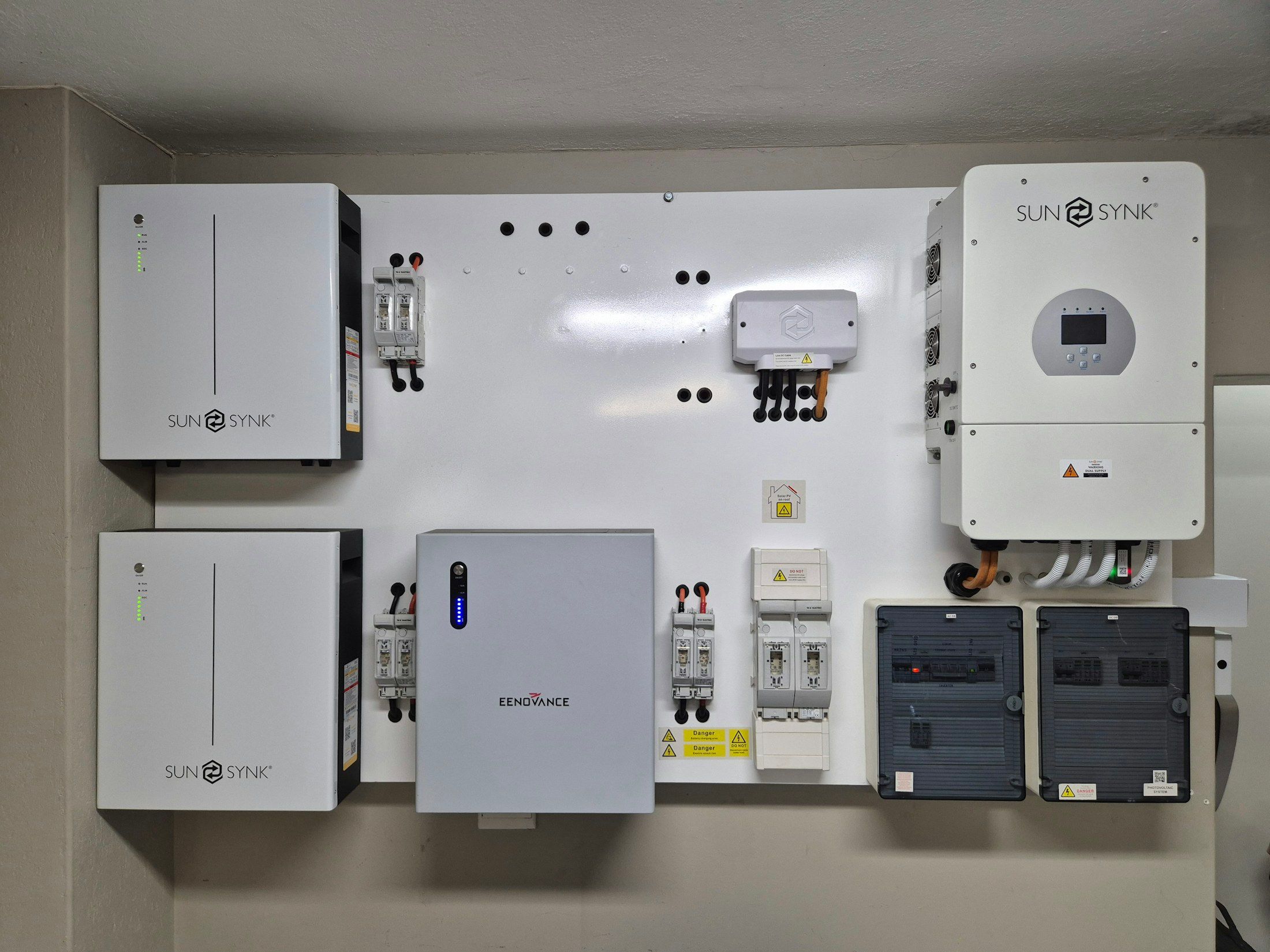
- A hybrid inverter with a backup output. A hybrid inverter manages solar panels and a battery together. Some models include a backup or off-grid output; others do not.
- A backup gateway or changeover device. This detects a blackout, disconnects your home from the grid and switches the backed-up circuits over to the battery. It may be built into the inverter or be a separate unit.
- A backup sub-board. For essential-circuits backup, the chosen circuits are moved into their own board.
- Switchboard work. Older switchboards may need upgrading before backup can be added safely.
Ask how long the changeover takes. Some systems switch over quickly enough that you barely notice. Others take longer, and computers, modems or clocks may restart.
Also ask whether your solar panels keep working during an outage. Some backup systems let the panels recharge the battery while the grid is down, which can matter a great deal in a long outage. Others only run the battery until it is empty.
Power versus energy
Two numbers decide what a battery can do in a blackout:
- Energy (kWh) is how much is stored, so it sets how long you can keep going.
- Power (kW) is how much the system can supply at once, so it sets how many appliances you can run together.
A battery with plenty of stored energy but a modest power output may still struggle to run an oven, a kettle and air conditioning at the same time. Our guide to what size battery you need explains both.
How much is in the battery when the power goes out matters too. Many systems let you set a backup reserve, a level the battery will not discharge below in everyday use, so some charge is always kept for outages. A higher reserve gives you more security but leaves less capacity for daily savings. If you are in a virtual power plant, ask how its events interact with that reserve.
Why backup changes the price
Backup adds cost because it can involve extra hardware, extra wiring, a separate sub-board, more labour and sometimes a switchboard upgrade. Whole-home backup may also need a larger inverter.
The federal Cheaper Home Batteries discount is calculated on the battery's usable capacity, so adding backup hardware does not increase it. When you compare quotes, check whether each one includes backup, what kind, and which circuits. A cheaper quote without backup is not comparable with a dearer one that includes it. Our guide on how to compare solar quotes has more on reading quotes line by line, and the battery rebate calculator shows the discount side.
What to ask your installer
- Does this system provide backup during a blackout? If so, what type?
- Which circuits will be backed up? Can I see them listed in writing?
- What is the maximum power (kW) available in backup mode?
- How long does the changeover take? Will my devices restart?
- Can my solar recharge the battery during an outage?
- Can I set a backup reserve, and what do you recommend for my use?
- Does my switchboard need work first, and is that included in the price?
- How do I test the backup, and how will I know it is working?
- If we have three-phase power, does backup cover one phase or all three?
For a broader checklist, see our questions to ask a solar installer.
Safety: a job for a licensed electrician
Backup wiring is not a DIY job. Getting the grid separation wrong can send power back into the network, which puts line workers at risk, or cause a fire in your home. Only a licensed electrician should do this work. For the federal discount, the installation must also be done with a Solar Accreditation Australia (SAA) accredited installer present, and since 1 March 2026 installers must take geotagged, time-stamped photos of the battery's labels for compliance.
Never connect a battery, generator or portable power station to your home's wiring with a homemade lead or adaptor. It can back-feed the grid and is dangerous. Portable batteries are also outside the federal program.
If anyone in your home relies on life support equipment, do not depend on a home battery alone. Talk to your retailer about life support registration and have a separate plan for outages.
Test it before you need it
At handover, ask your installer to show you the system running in backup mode, for example by switching off the main supply in a controlled way. Learn how to check the battery's charge and backup reserve in the app. Keep the list of backed-up circuits somewhere you can find it in the dark.
The short version
- A battery does not work in a blackout unless the system includes backup hardware and wiring.
- Essential-circuits backup runs chosen circuits; whole-home backup aims to run the whole switchboard but usually costs more and needs more power.
- Both stored energy (kWh) and power output (kW) limit what you can run during an outage.
- Backup adds to the price, and the federal discount does not grow with it, so compare quotes like for like.
- Backup work must be done by a licensed electrician, never DIY. When you are ready, get quotes that spell out exactly what is backed up.
Sources
- DCCEEW, Cheaper Home Batteries Program
Checked 23 September 2026
Questions people also ask
Do all home batteries work during a power outage?
No. A battery only powers your home in an outage if the system includes backup hardware and has been wired for it. Without that, it switches off with the grid for safety.
Can my solar panels charge the battery during a blackout?
Some backup systems can keep the panels running to recharge the battery during an outage, and some cannot. Ask your installer how your chosen system behaves before you sign.
Can I add blackout backup to a battery I already have?
Sometimes. It depends on whether your inverter supports a backup output and on your switchboard. A licensed electrician or your original installer can tell you what would be involved.
How long will a battery run my house in a blackout?
That depends on how much charge is left when the power goes out, which circuits are backed up and what you run. Running a few lights and the fridge uses far less than cooking and air conditioning.