Australia's new EV charging roadmap is underway. What does it mean for a home with solar?
Australia's new EV charging roadmap will plan infrastructure to 2035. It does not change today's home solar rebates or charger rules, so households should focus on charging times and safe wiring.
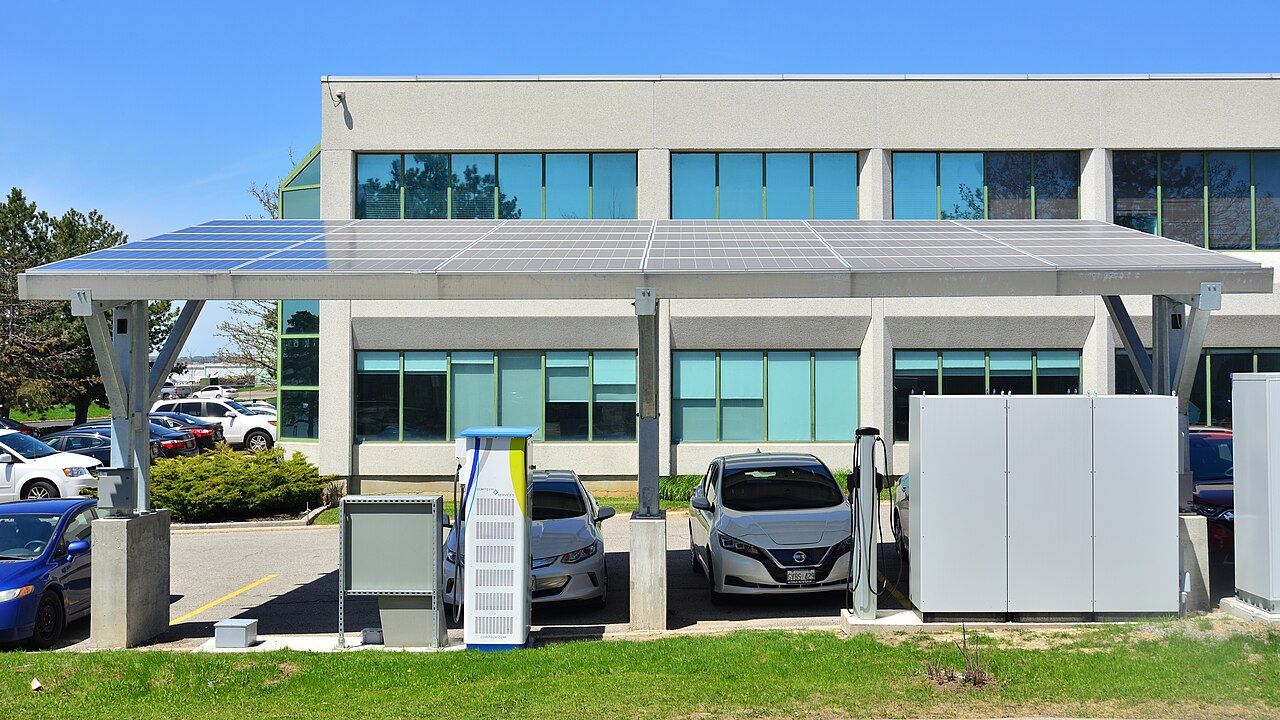
An illustrative solar-powered EV charging station, not a project image for Australia's new roadmap or a home charging setup. Illustrative image: Wikimedia Commons, SolarPoweredEVCharging.jpg. Credit: Raysonho / Wikimedia Commons. CC0 1.0. Resized and cropped for display.
The Australian Government announced on 19 October 2026 that work is under way on a National EV Charging Roadmap. The Electric Vehicle Council is leading the project, with $1.06 million from the Australian Renewable Energy Agency toward a $1.43 million project. It is intended to map demand for charging, pressure points on electricity networks and investment priorities for passenger and heavy vehicles out to 2035. The roadmap itself is due in mid-2027.
For a household with solar panels, the announcement matters because an EV can become one of the home's largest flexible electrical loads. Yet it would be wrong to read today's announcement as a new solar subsidy, a home-charger mandate or a promise of a public charger near your street. Those are not in the announcement. The immediate decision is still how you will charge safely and affordably with the system and electricity plan you have, while the public and industry planning work proceeds.
What the project will actually produce
ARENA's project page describes three streams: improving charging data, forecasting where different types of infrastructure may be needed, and testing policy and market options. Its scenarios cover cars, trucks and buses. It is designed as a shared planning tool, not a fixed prediction of exactly which charger will appear at a given address or which company will build it. A steering committee includes government, industry, consumer, network and investment voices, with opportunities for broader input.
The government announcement says the project will bring together vehicle makers, charging providers, electricity networks, fleet operators and consumer groups. That mix is relevant to solar homes. Public charging, home charging and power-system planning affect each other, but they do not have identical costs or practical constraints. Someone with a driveway and weekday access to their parked car may use a rooftop array differently from an apartment resident dependent on street or destination charging. A national plan should make those differences visible rather than treating every EV driver as a home-charging household.
Your solar panels can charge a car, but timing matters
The government's EV charging advice recommends using rooftop solar while it is generating and considering smart charging that can follow surplus solar or lower-priced grid periods. Solar electricity first serves the home's current loads; the charger can use some of what remains. If the car is usually away during sunny hours, most of its charging may instead occur after dark. That can be a perfectly workable arrangement, but the energy will usually come from the grid unless you have storage or another supply option. A solar panel on the roof does not make every night-time EV charge a solar charge.
Charging from a normal household power point is slower but can suit some driving patterns. Energy.gov.au puts that option at up to 2.4 kW and says a dedicated home charger is typically 7 to 22 kW; a licensed electrician must install a dedicated charger and may need to assess the switchboard or supply connection. The right speed depends on the car, kilometres driven, time parked and your electrical installation. More power is not automatically a better solar match: a fast charger can draw more than the array's available surplus and import the difference at the prevailing tariff.
If you are buying solar with a future EV in mind, ask the installer to model your likely parking and charging times rather than simply adding panels to a standard package. Our solar system sizing guide explains how to start from household consumption, roof conditions and likely daytime use. A quote should show the proposed generation profile, inverter size and any network export condition. If you already have solar, look at the monitoring data for genuine midday surplus before paying for an extra array or a charger with solar-following features. Seasonal production changes, so one very sunny day is not a reliable annual forecast.
The plan matters as much as the charger
An EV can make more of your own midday solar useful. That may reduce exports and increase self-consumption, but it also means giving up whatever feed-in payment those exports would have earned. Compare the actual plan's import rates, time-of-use windows and feed-in rate; our feed-in tariff guide explains why the headline feed-in number is only one part of the bill. A household that cannot charge at home during the day may get more value from a suitable off-peak schedule than from pursuing a perfect solar-only charge that its routine rarely permits.
The independent government home and strata charging guidance also distinguishes houses from shared buildings. A dedicated charger in an apartment garage can need strata approval and an electrical design for the shared supply. National public-charging planning will matter particularly to drivers who lack a private driveway, but it does not remove today's need to agree on building permissions and meter arrangements. If you rent, confirm what equipment you may install and how you would pay for its electricity before ordering a charger.
What to do now, without waiting for 2027
First, calculate the electricity your usual driving requires and when the vehicle is parked at home. Second, check your solar monitoring and electricity tariff for the same periods. Third, ask a licensed electrician whether the existing circuit or a dedicated charger is safe and suitable; do not use a power board or an improvised extension lead as a permanent EV charging solution. Fourth, compare quotes for any solar or charger upgrade using the exact equipment, switchboard work, network approval and warranty. Our quote comparison guide helps keep those costs visible.
The roadmap may eventually give governments and networks better evidence about where charging needs to grow. It cannot yet tell a family which charger to buy or guarantee their solar economics. The practical gain today is to plan the car, home wiring, solar output and tariff as one system, while keeping the public-infrastructure announcement in its proper, longer-term context.
Written by the SolarAnswers editors
We link the reporting, government, industry or manufacturer sources behind each story below, and distinguish reported claims from our own analysis. We do not sell equipment, and no installer or brand pays to be written about. How we are paid
Sources
- Australian Government, National EV charging roadmap project
Checked 19 October 2026
- ARENA, Electric Vehicle Council National EV Charging Roadmap project
Checked 19 October 2026
- Australian Government, How to charge your electric vehicle
Checked 19 October 2026
- Australian Government, Charging options for houses and strata buildings
Checked 19 October 2026
- Solar Victoria, Getting your home EV-ready
Checked 19 October 2026

Comments
If comments do not appear, reload this page or browse the community.