Apartment solar sharing wins top design honours for SolShare
Allume Energy has won major Australian design awards for technology that shares rooftop solar between apartments. The recognition puts a familiar housing barrier in focus.
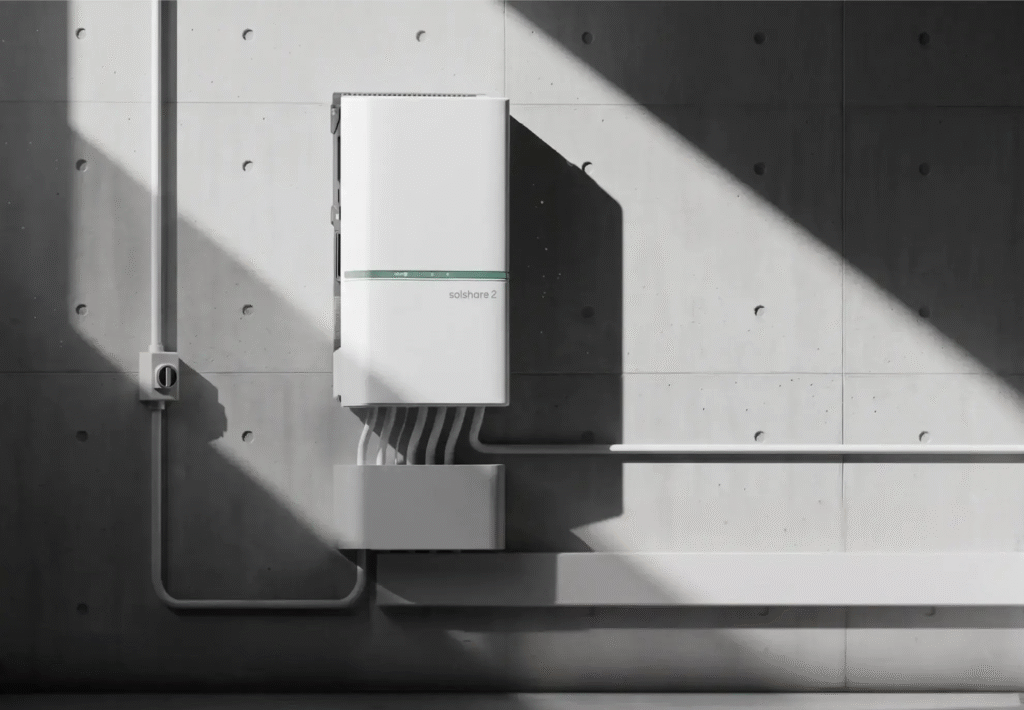
Image reproduced from: pv magazine Australia, Rooftop solar sharing system wins top design award. Credit: Allume Energy, as credited by pv magazine Australia.
Allume Energy's SolShare has received two major Australian design awards for tackling a familiar problem: an apartment building may have a suitable roof, while the people living beneath it still struggle to receive solar electricity on their individual accounts.
The technology shares output from one solar system between separately metered homes. The recognition is significant because the design problem includes the building, its residents and its existing electricity arrangements, as well as the hardware installed in the switchboard area.
What the award recognises
Good Design Australia named SolShare its 2026 Award of the Year winner and recipient of its Sustainability Award. Its announcement describes a system that allows residents to retain their existing electricity meters and retailers while sharing rooftop generation.
The award organisation reports more than 13,000 apartments connected and more than 28 GWh delivered through the technology. Those are the published adoption figures, not an independent SolarAnswers audit. They indicate deployment beyond a prototype, but do not establish the savings or suitability of a future installation at another building.
The recognition was covered by pv magazine Australia on 13 October. Allume's own announcement provides the company's account of the awards.
How the manufacturer describes the sharing
Allume's product explanation says its hardware distributes electricity from a single rooftop array between participating apartments and common areas. A dynamic allocation system responds to consumption, with each household's share balanced across the month.
The company describes ownership through owners corporation assets and installation by its certified partners. It offers a building-level feasibility assessment covering system size, costs, estimated savings and available funding.
These are the manufacturer's descriptions. A proposal still needs to show how they apply to the actual building, including its electrical layout and the agreed allocation. General compatibility claims do not replace an installation design.
Common-area solar and apartment solar solve different problems
A building can put solar on its common-property meter to supply lifts, corridor lighting or other shared loads. That may benefit owners through reduced common expenses, but it does not necessarily reduce the electricity billed directly to each apartment.
A shared system supplying individual dwellings must explain how power reaches those homes and how participation is recorded. This is why a comparison based only on the number of roof panels can miss the main design question.
Before considering a price, the owners corporation should define the objective. Is it reducing common-property bills, providing energy to residents, or both? The proposal and its financial calculation should use the same objective.
What a feasibility assessment should make visible
Start with the available roof area and electrical infrastructure. Ask which apartments can participate, what access is needed, and whether the proposed cabling and equipment fit without unexpected work elsewhere in the building.
Then examine allocation. How is each dwelling's share set? How is unused energy handled? How are common-area loads treated? What happens if an owner joins later or a dwelling is temporarily vacant?
The answers affect both fairness and the financial estimate. Two apartments with the same allocation can use electricity differently during the day. A building-wide saving should not automatically be presented as an identical saving for every resident.
Ownership, maintenance and changes of resident
The owners corporation needs a clear record of who owns each component and who can authorise maintenance. It should also understand the warranty process, ongoing service costs and who is responsible if monitoring or allocation stops working.
Residents need a usable explanation of what changes on their electricity account and what remains their responsibility. A new tenant or purchaser should be able to understand the arrangement without relying on the memory of the committee that approved it.
For that reason, a useful approval package includes the design, the allocation agreement, the cost-sharing proposal and the maintenance plan. A presentation that supplies only a projected savings percentage leaves too much unresolved.
What the award does and does not settle
The awards recognise a design contribution to making shared solar accessible. They do not constitute a planning approval, a guarantee of performance at your building or proof of a particular payback period.
The practical next step is a feasibility assessment that owners can read and compare. It should separate common-area and apartment benefits, identify assumptions and show how the system will be operated after installation. That is where the promise of shared solar becomes a decision a building can make with confidence.
Written by the SolarAnswers editors
We link the reporting, government, industry or manufacturer sources behind each story below, and distinguish reported claims from our own analysis. We do not sell equipment, and no installer or brand pays to be written about. How we are paid
Sources
- pv magazine Australia, Rooftop solar sharing system wins top design award (2026-10-13)
Checked 15 October 2026
- Allume Energy, award announcement, published 9 October 2026
Checked 15 October 2026
- Good Design Australia, SolShare award announcement, 13 October 2026
Checked 15 October 2026
- Allume Energy, SolShare product operation, ownership and installation guidance
Checked 15 October 2026
Comments
If comments do not appear, reload this page or browse the community.