Is a shaded roof still worth using for solar?
Trees and nearby buildings can reduce solar output. Before you buy, ask for a roof-specific layout, shade estimate and bill calculation.
SolarAnswers editors, updated , 5 min read
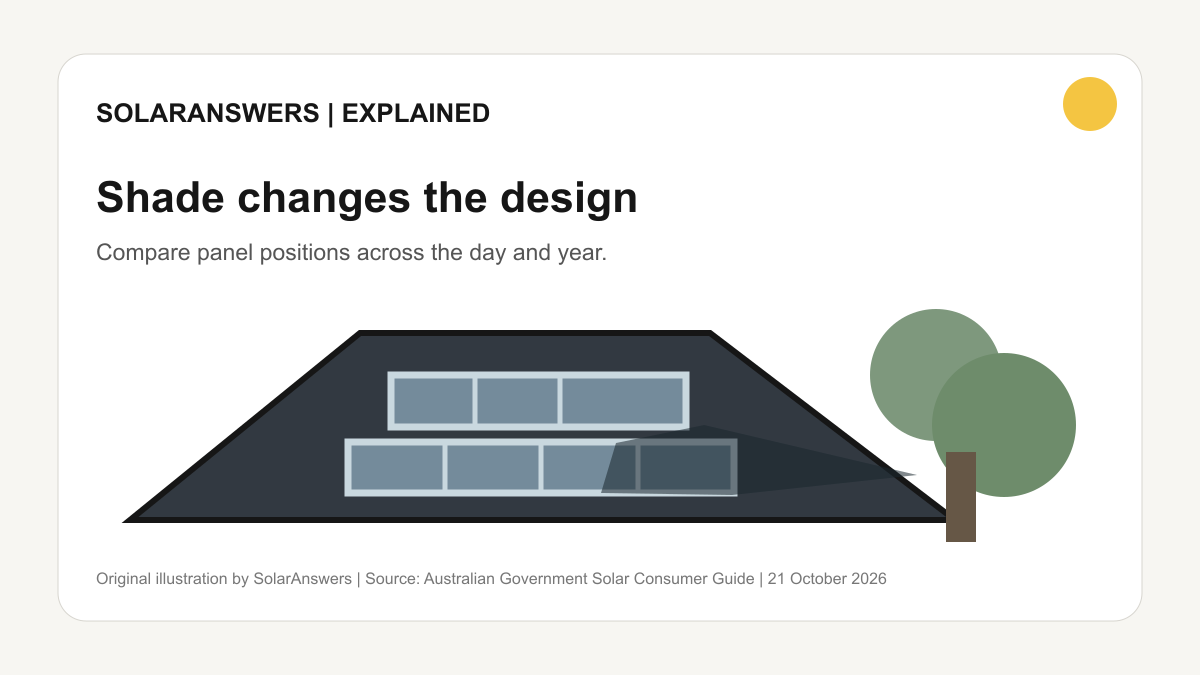
Original SolarAnswers illustration. Shade changes through the day and year. Source: Australian Government Solar Consumer Guide.
The tree beside your house gives welcome shade in summer. It may also cross the only convenient part of the roof during the hours when solar panels would otherwise generate electricity. An installer says it is fine; another says the system will never pay for itself. Neither blanket answer tells you enough. The useful question is how much sunlight each proposed panel position receives over a year, and whether the resulting energy is valuable to your household.
The Australian Government's Solar Consumer Guide says panels generate less electricity when shaded by trees, buildings or other obstructions. It also says a little shading does not necessarily make a project unviable, while shade lasting for long periods can make it uneconomic. The amount changes with the height and position of the obstruction, the time of day and the season. A photo taken at noon on a clear October day cannot describe what a winter morning will do to that roof.
Map the shadow before choosing the hardware
Ask each installer to show the proposed panel layout over a roof photograph or plan, marking skylights, vents, antennas and shaded areas. Ask which objects cause the shade and at what times. A neighbouring building is relatively fixed; a tree canopy can grow or be pruned, subject to local rules. The government guide specifically asks owners to consider future tree growth and planned development. It points to SunSPOT as a way to examine roof potential. SunSPOT says its premium version estimates shade losses where participating councils provide the underlying data; otherwise users can estimate shade themselves. It is a planning aid, not a substitute for an installer checking the actual site.
The best roof face is not always the most visually obvious one. Orientation, tilt and available area all matter. According to the government's design guidance, panels on a steep south-facing roof generate less electricity and may not be cost-effective. Flat roofs can sometimes use tilt frames, but the rows need spacing to avoid shading each other and the framing adds cost. The answer may be to use an east or west section, split the array across several roof faces, or install fewer panels in the clear area. A quote should show the effect of those alternatives instead of simply filling every available patch of roof.
The system's rated size is not the energy it will produce every day. The government's panel guide distinguishes kilowatts of rated power from kilowatt-hours of electricity generated. It says location, roof slope, direction and other factors change annual output. That is why a “10 kW system” on a partly shaded roof cannot be compared fairly with another 10 kW proposal using nameplate capacity alone. Request estimated annual generation, monthly variation and the shading assumption used in the model. If a company gives only a single annual number, ask to see how it was calculated.
Ask what happens when shade reaches part of the array
Panels are connected and managed through an inverter arrangement, and installers may propose different equipment when shade affects only some modules. A string inverter, microinverters or module-level electronics can each be appropriate in different designs; none makes a tree disappear. Ask the designer to show an output estimate for the same roof under each proposed configuration and to explain any added equipment cost, replacement access and warranty responsibility. Our guide to comparing solar quotes helps you put the equipment and assumptions side by side. Treat a promise that optimisers “solve shade” as a reason to request measured modelling, not as proof.
Also compare when the system generates with when you use electricity. If a western tree shades late afternoon, it may reduce generation during the hours your household returns home, even if the annual total looks respectable. If your home is empty on weekdays, exported electricity may have a different value from electricity used on site. The government's advice on getting the most from solar says using more of your generation in the home is generally the strongest way to improve the bill result. The right layout therefore depends on both production and consumption. Ask for a bill model using your actual tariff, daytime usage and any export limit, rather than a generic savings headline.
Do not assume removing the tree is free
Pruning might help, but a tree has value as shade, habitat and amenity, and you may need permission to alter it. The government maintenance guidance says to use a qualified arborist or landscaper and notes that local permission may be needed for substantial tree work. A proposal that depends on annual pruning should include its realistic cost. It should also consider the cooling benefit you would lose if a large tree were removed. A solar sales representative should not make that decision for you.
Roof condition comes first too. The design guide recommends repairing or replacing a roof likely to need work in the next few years before panels go on. For a shaded home, paying to install a marginal array and then removing it for roof work can undermine the economics. Structural constraints, heritage rules and safe installer access may narrow the design further. These are questions to settle before the contract, not surprises on installation day.
A quote you can actually judge
Ask for two or three clearly drawn options: the highest expected annual output, the best fit for your daytime and evening use, and a lower-cost design that avoids the worst shade. Each should show array size, inverter choice, predicted monthly generation, shading assumptions, equipment and installation warranties, export assumptions and total installed price. Ask who will update the estimate if the onsite inspection differs from the remote design. If the seller cannot explain why panels are placed in a shaded area, ask for a revised layout.
After installation, use the monitoring access supplied at handover to establish a baseline and identify unexpected changes. The Solar Consumer Guide's monitoring page explains that generation varies by season and that some systems can reveal poor performance or shade-related losses. Our handover checklist covers the records and login details to keep. A good design is one whose assumptions you can inspect before buying and whose performance you can observe afterwards.
Shade makes a solar decision more individual, not impossible. If the usable roof is small and poorly lit, the honest answer may be a smaller system or no system. If only one part of the roof is affected, a careful layout may still produce worthwhile energy. The difference lies in a site-specific estimate, transparent financial assumptions and a design you can compare, not in a salesperson's confident one-line answer.
Sources
- Australian Government Solar Consumer Guide, design considerations
Checked 21 October 2026
- Australian Government Solar Consumer Guide, solar panels
Checked 21 October 2026
- Australian Government Solar Consumer Guide, get the most from your solar system
Checked 21 October 2026
- Australian Government Solar Consumer Guide, look after your solar system
Checked 21 October 2026
- Australian Government Solar Consumer Guide, monitor your solar system
Checked 21 October 2026
- SunSPOT solar calculator
Checked 21 October 2026
Questions people also ask
Can solar panels work on a partly shaded roof?
Yes, but output depends on when and how long each panel is shaded. Ask for a site-specific generation estimate and layout before buying.
Will an optimiser fix shade on solar panels?
No equipment can create sunlight where a panel is shaded. Ask for comparable generation models and total prices for each proposed inverter design.
Should I remove a tree before installing solar?
Not automatically. Consider its cooling and amenity value, pruning costs and local permissions, then compare a solar layout that avoids the shade.