New England Solar's 244-tonne delivery: what it takes to get solar onto the grid
A 244-tonne transformer has reached New England Solar near Uralla. The delivery highlights the work between building a solar project and getting its additional power onto the grid.
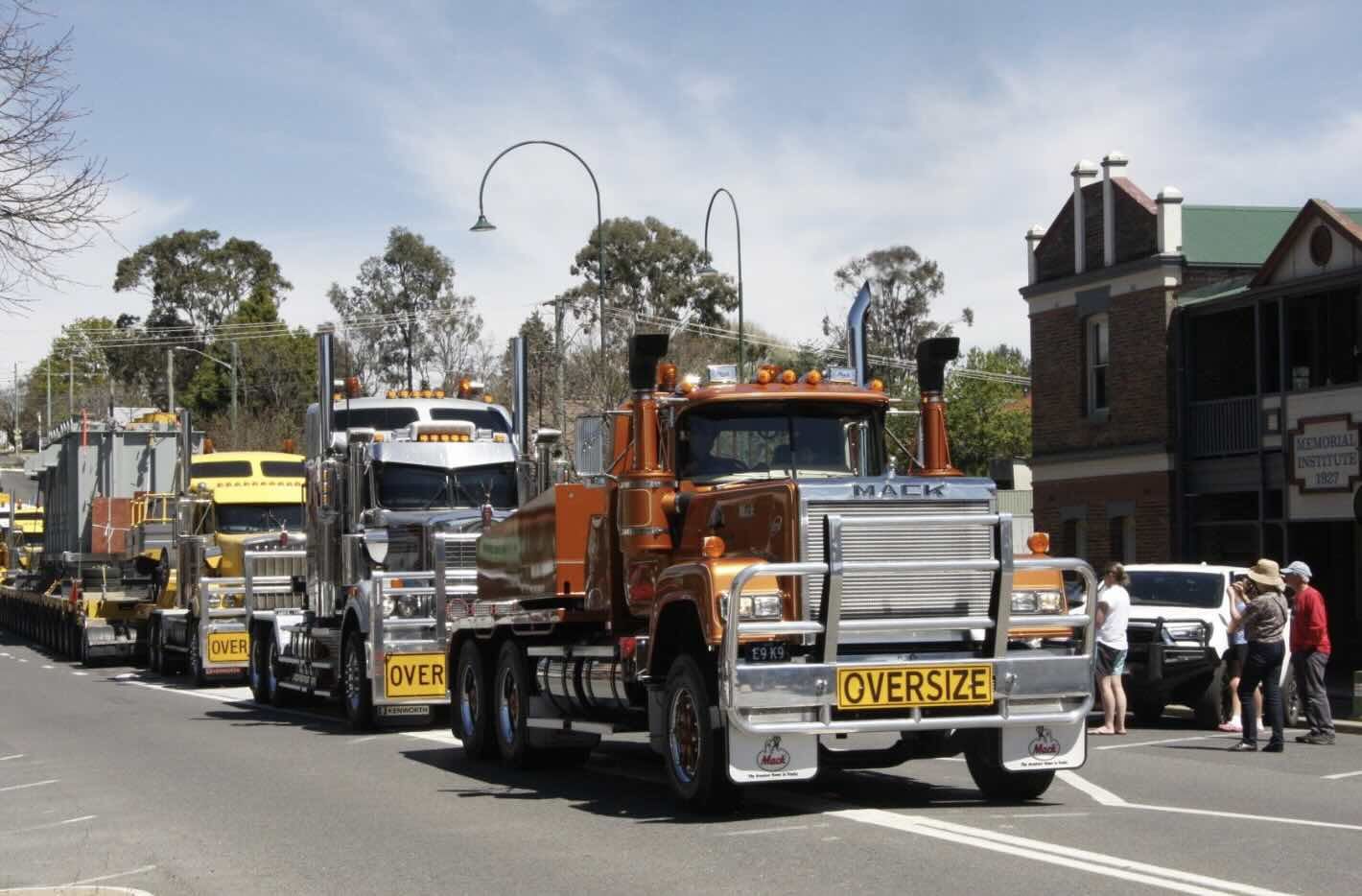
The transformer transport convoy pictured in RenewEconomy's report on the New England Solar delivery. Image reproduced from: RenewEconomy, A massive 244-tonne transformer completes 2,165 km road trip to Australia's largest solar project. Credit: Acen Renewables, as credited by RenewEconomy.
A transformer weighing 244 tonnes has reached the New England Solar substation near Uralla, NSW, after a 2,165 km journey from Port Adelaide. It is a substantial piece of the project's next stage. It also illustrates why adding solar capacity involves much more than putting panels in a field.
Developer ACEN Australia announced the delivery on 8 October 2026, saying installation was underway. RenewEconomy's coverage on 17 October brought the milestone back into the news. The reporting date should not be mistaken for the date the equipment arrived; ACEN's update does not give the precise delivery day.
For electricity customers, the distinction worth following is between equipment reaching a site and additional power being available to the grid. This announcement confirms progress on the former. It does not establish that the full solar expansion is operating.
What was delivered
ACEN describes the transformer as the largest and heaviest supplied to New England Solar. Its update gives dimensions of 11 metres long and 4.4 metres high, and says transport required an 18-axle modular trailer in a convoy about 70 metres long.
The company identifies EPEC Group as its partner for construction of the Stage 2 substation. ACEN's original delivery update.
These details show the scale of the logistical task. They are not measures of the electricity the transformer itself generates: a transformer is connection equipment, not another field of solar panels.
The delivery is therefore best understood as a construction milestone supporting the expansion. It should not be added to national solar-generation totals as though the journey had brought a completed power station online.
Separate the operating plant from the planned total
ACEN's project page describes New England Solar as a 720 MW development being delivered in stages. It says Stage 1, at 400 MW, began generating in 2023. The site is near Uralla and is crossed by an existing 330 kV transmission line. ACEN project information, checked 17 October.
The same page says the Stage 2 construction schedule will be announced. That wording matters when interpreting a report about equipment delivered for Stage 2.
| Part of the development | Position described on ACEN's project page |
|---|---|
| Solar Stage 1 | 400 MW, generating since 2023 |
| Full solar development | 720 MW, delivered in stages |
| Solar Stage 2 schedule | To be announced |
| New England battery | 200 MW with two-hour duration, undergoing final testing and commissioning |
Source: ACEN's live project page. These are developer descriptions checked on 17 October 2026, not independent certification of current output.
Subtracting the operating solar stage from the stated total gives 320 MW of additional solar capacity. That arithmetic does not supply a commissioning date or demonstrate how much of the expansion is ready.
It also avoids a common reading error: the 720 MW project figure should not be described as 720 MW of newly operating solar added by this delivery.
Why the connection work is consequential
A solar project has to function as part of a wider electricity system. Physical construction is one part of that task; demonstrating that the completed equipment meets its agreed performance requirements is another.
AEMO's connection-completion guidance says registration is separate from the connection process and must be completed before commissioning. It also requires an appropriate commissioning program and on-site testing to demonstrate compliance with performance standards. AEMO: completion of network connections.
The guidance describes reviews of test results and plant performance involving AEMO and the connecting network service provider. It also sets out model-validation and subsequent compliance-monitoring requirements.
Those are general requirements. They do not mean New England Solar has failed a test, encountered a delay or has any particular outstanding technical problem. No such conclusion follows from the delivery announcement.
For a reader tracking progress, the practical questions are more useful than a single completion percentage. Has a construction schedule been confirmed? Has commissioning begun for the relevant stage? What operating milestone is the developer actually announcing? Keep each answer attached to its date.
Solar capacity and battery duration answer different questions
The project's battery should also be kept separate from the solar figures. A megawatt describes power, while a megawatt-hour describes an amount of energy. A battery's duration provides another piece of information about the relationship between those quantities.
For a simple arithmetic illustration, 200 MW sustained for two hours corresponds to 400 MWh. That does not establish the plant's usable stored energy under every operating condition, its daily dispatch or a guaranteed period of supply to particular homes.
The battery and solar components can play different roles in an electricity system. ACEN's page places them at different stages of delivery, so describing the whole site as simply finished or unfinished would lose useful information.
Our coverage of how batteries are changing the wholesale market explains the broader role of storage. It should not be read as a commissioning update for this particular project.
What does this mean for household bills?
More completed generation and storage can improve the electricity market, but a delivery photograph cannot establish a dollar saving on your next bill.
In its 20 August 2026 review, the Australian Energy Regulator said growing renewable supply and batteries had helped ease wholesale-market pressure in 2025. It also highlighted the importance of capacity being available in the right places and at the right times, alongside transmission and demand response.
The regulator explicitly cautioned that wholesale-price changes do not flow immediately or dollar-for-dollar into retail bills. AER's market-performance findings.
That makes a more useful household interpretation than treating one project's planned megawatts as a bill forecast. The project can be relevant to the wider supply picture while your own costs still depend on your electricity contract and usage.
The government's tariff guide distinguishes fixed charges, usage charges and export credits. Reviewing those terms remains a practical step you can take now, without assuming when a large project will change market prices.
Read the next announcement against this baseline
The next useful update would add information that the transformer announcement does not contain: a clearer Stage 2 schedule, commissioning progress or confirmed additional operating capacity.
Keep the reference points separate: 400 MW of solar described as operating since 2023; a planned 720 MW solar development; a separate battery undergoing testing according to the developer; and a transformer delivery announced on 8 October.
For local residents, construction details can matter independently of the national energy debate. The developer's project page provides community information and updates, which are better starting points for project-specific questions than a general national headline.
For solar households elsewhere, the lesson is to distinguish a credible step forward from the final result. Equipment delivery deserves attention because connection infrastructure matters. Its value becomes clearer as the next stages are completed and their operating results can be observed.
Sources and dates
All sources were accessed on 17 October 2026.
- ACEN Australia, New England Stage 2 transformer delivered to site: published 8 October 2026; exact delivery day not stated.
- ACEN Australia, New England Solar project page: live project description; no single page-update date displayed.
- RenewEconomy, A massive 244-tonne transformer completes 2,165 km road trip to Australia's largest solar project: Giles Parkinson, 17 October 2026. Used as the current reporting hook; the article does not independently endorse the national size ranking.
- AEMO, Completion: current general connection and commissioning guidance; no publication date displayed.
- AER, Renewables and battery growth ease pressure in wholesale electricity market: issued 20 August 2026, discussing 2025 market outcomes.
- Australian Government, Electricity pricing plans and tariffs: no publication date displayed.
Written by the SolarAnswers editors
We link the reporting, government, industry or manufacturer sources behind each story below, and distinguish reported claims from our own analysis. We do not sell equipment, and no installer or brand pays to be written about. How we are paid
Sources
- ACEN Australia, New England Stage 2 transformer delivered to site
Checked 17 October 2026
- ACEN Australia, New England Solar project page
Checked 17 October 2026
- RenewEconomy, A massive 244-tonne transformer completes 2,165 km road trip to Australia's largest solar project
Checked 17 October 2026
- AEMO, Completion
Checked 17 October 2026
- AER, Renewables and battery growth ease pressure in wholesale electricity market
Checked 17 October 2026
- Australian Government, Electricity pricing plans and tariffs
Checked 17 October 2026
Comments
If comments do not appear, reload this page or browse the community.