LGI signs a $22 million deal for two operating Queensland solar farms
LGI has agreed to acquire the Brigalow and Chinchilla solar farms. The deal also opens a possible path to storage additions, although those battery plans remain preliminary.
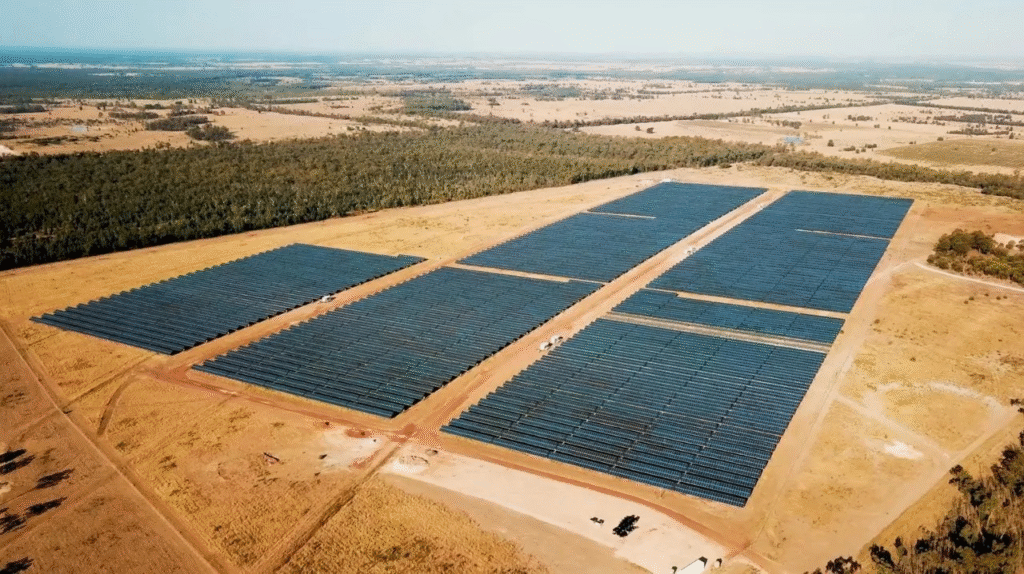
Image reproduced from: pv magazine Australia, Queensland solar farms change hands in $22 million deal. Credit: Risen Energy, as credited by pv magazine Australia.
LGI's Queensland solar acquisition brings two operating plants into the discussion about what existing renewable assets are worth, and how adding storage might change their role. The reported $22 million agreement covers Brigalow and Chinchilla, with a combined installed panel capacity of 54.4 MW.
The plants' ability to export is lower than that installed figure. Keeping those ratings separate is essential when comparing the transaction price, generating capability and possible future battery investment.
What was reported on 12 October
pv magazine Australia's report describes a binding agreement between LGI and IIG Solar Asset Trust. Chinchilla has 19.9 MW of installed capacity and 14.7 MW of export capacity; Brigalow has 34.5 MW installed and 27.3 MW of export capacity.
The report says Chinchilla began commercial operation in 2019 and Brigalow in 2021. LGI described the purchase price as below the development cost of comparable new assets. That is the buyer's valuation claim, not a replacement-cost assessment carried out by SolarAnswers.
The agreement also included a possible next chapter: LGI said preliminary studies supported consideration of batteries at the sites. A preliminary assessment is not a final investment decision, construction contract or commissioned storage system.
What LGI says about operating the assets
LGI's Brigalow project page describes the company as having acquired a 100% operating interest in both farms. It identifies their combined capacity as approximately 42 MW AC and 54 MW of panels, and describes plans to use its Dynamic Asset Control System to manage dispatch.
The company says the control system can respond to price changes and curtail output when spot prices are negative. It also presents co-located storage as a future opportunity alongside its existing landfill biogas generation portfolio.
The project page does not provide a settlement date in the material reviewed. We therefore distinguish the dated news report about the binding agreement from the company's current description of ownership, without inventing a completion date.
Why there are two capacity totals
Adding the published panel ratings gives 34.5 + 19.9 = 54.4 MW. Adding the export ratings gives 27.3 + 14.7 = 42 MW. The first describes the installed solar array; the second describes the reported export capability.
Using the same $22 million price, division by 54.4 MW produces about $404,000 per MW of installed panels. Division by 42 MW gives about $524,000 per MW of export capability. These are SolarAnswers calculations from the reported transaction and ratings, rounded to the nearest thousand dollars.
Neither calculation is an all-purpose valuation metric. They show why a price-per-megawatt comparison needs to specify its denominator. They also do not include an independent assessment of asset condition, liabilities, operating costs or the value of future opportunities.
What storage could change
A solar plant can only sell the energy it produces when it is available unless some output is stored. Adding a battery could allow a portion to be sold later, subject to losses, storage capacity and connection arrangements.
That possibility does not prove the investment will pay. A detailed study would need to compare the value of shifted energy and other services against charging costs, battery cost, operating expenditure and degradation. It would also need to establish whether the existing connection can support the proposed charging and discharge arrangement.
Control software and storage solve related but different problems. Curtailing output can avoid generating into an unfavourable price interval. A battery may preserve some energy for later use, but it adds equipment and operating obligations. The cost-benefit comparison must include both.
How to judge the next announcement
A meaningful battery update would identify a proposed power rating, storage capacity, connection approach and investment status. A statement that a site is suitable for storage does not provide those details.
For the existing farms, useful operating evidence includes actual generation, availability, curtailment and realised revenue over comparable periods. Those measures would help assess whether the acquisition and dispatch strategy are delivering the expected result.
For household readers, the transaction is evidence about operating solar assets and industry strategy. Its price cannot be used as a rooftop installation benchmark: the assets, scale, connection and commercial obligations are different. The main lesson is to compare like with like, especially when one headline uses panel capacity and another uses export capacity.
Written by the SolarAnswers editors
We link the reporting, government, industry or manufacturer sources behind each story below, and distinguish reported claims from our own analysis. We do not sell equipment, and no installer or brand pays to be written about. How we are paid
Sources
- pv magazine Australia, Queensland solar farms change hands in $22 million deal (2026-10-12)
Checked 15 October 2026
- LGI, Brigalow Solar Farm project overview and Queensland solar portfolio
Checked 15 October 2026

Comments
If comments do not appear, reload this page or browse the community.