Samsung seeks environmental approval for the Darnum battery in Victoria
A proposed 200 MW, 800 MWh battery near Warragul has entered federal environmental assessment. The application is a development milestone, rather than approval to operate.
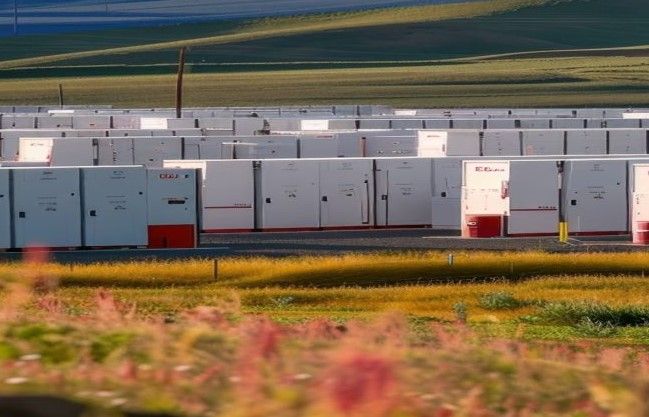
Image reproduced from: pv magazine Australia, Samsung C&T seeks approval for 800 MWh BESS in Victoria. Credit: Samsung C&T Renewable Energy Australia, as credited by pv magazine Australia.
A proposed battery near Warragul would add 200 MW of power capacity and 800 MWh of storage to Victoria's electricity system. Samsung C&T Renewable Energy Australia's Darnum project has entered federal environmental scrutiny, while a separate Victorian planning application provides details residents can examine now.
Those two processes should be kept distinct. A proposal appearing in an assessment system is a step in development, not confirmation that all approvals are complete or construction has begun.
The location and proposed connection
The developer's Darnum consultation material identifies a site on Darnum-Shady Creek Road in the Baw Baw local government area, about eight kilometres north-east of Warragul. The proposal includes battery enclosures, power conversion equipment, cabling, a substation and supporting infrastructure.
An existing AusNet 220 kV transmission line crosses the site near its southern boundary. The developer proposes connecting the battery to the National Electricity Market through a substation linked to that line. Its consultation material says the development footprint remains indicative pending detailed design and procurement.
That last qualification matters. An early layout is useful for understanding the proposal, but it should not be treated as an immutable equipment schedule or final construction drawing.
What the environmental application means
pv magazine Australia's 13 October report describes Samsung seeking approval under the Environment Protection and Biodiversity Conservation Act. It reports a construction target of 2027 and a build taking up to 18 months.
The company presents the project as a way to store electricity during lower-demand periods and release it when needed, supporting the integration of variable renewable generation. Those are the project's intended functions. The timetable is a development target and remains subject to the steps needed to proceed.
We have not established a final federal decision from the material reviewed for this article. Nor should the proposed storage capacity be counted as operating capacity simply because an application has been lodged.
What is already available in the Victorian register
Victoria's ministerial permits register, application PA2604508, names Darnum BESS Pty Ltd as trustee for the Darnum BESS Trust. It identifies the land as 875 Darnum-Shady Creek Road, Shady Creek.
The entry records an application received on 2 July 2026 and public notice dated 2 September 2026. Supporting documents include assessments of noise, traffic, surface water, ecology and visual effects, along with a fire risk management plan, preliminary hazard analysis and development plans.
The presence of these documents does not mean the concerns they address have been resolved. They allow residents and decision-makers to examine the applicant's evidence. The register and responsible authority should be used to confirm the current submission process and decision status.
Understanding the four-hour description
Dividing the proposed energy capacity by the proposed power capacity gives four hours: 800 MWh / 200 MW = 4 hours. This is a nominal duration calculation using the published ratings. It is not a promise that the plant will export at full power for four hours every day.
Actual operation depends on how much energy is stored, the operating limits, losses, network conditions and the services being provided. A battery can also operate below its maximum power. A headline containing only megawatts therefore omits information needed to understand how much energy it can shift.
Questions that matter locally
For neighbours, the most useful questions are tied to the site documents. Where are the nearest sensitive receivers in the noise assessment? Which roads would carry construction traffic? How are drainage and emergency access handled in the layout? What changes between construction and normal operation?
An effective submission can identify a particular assumption or location and explain why it needs examination. That is more specific than either accepting the project's general benefits or rejecting it solely because it is a battery development.
For readers following electricity infrastructure, the next milestones are assessment decisions, any conditions, a firm construction commitment and ultimately commissioning. Each confirms something different. Environmental approval alone would not show that the project has been financed, built or successfully connected.
Darnum is consequently a project to follow through those milestones. Its scale and proposed connection are clear enough to explain its intended role, while its final design, approvals and delivery remain the matters to watch.
Written by the SolarAnswers editors
We link the reporting, government, industry or manufacturer sources behind each story below, and distinguish reported claims from our own analysis. We do not sell equipment, and no installer or brand pays to be written about. How we are paid
Sources
- pv magazine Australia, Samsung C&T seeks approval for 800 MWh BESS in Victoria (2026-10-13)
Checked 15 October 2026
- Samsung C&T Renewable Energy Australia, Darnum BESS public consultation overview
Checked 15 October 2026
- Victorian Department of Transport and Planning, Darnum BESS application PA2604508
Checked 15 October 2026
Comments
If comments do not appear, reload this page or browse the community.