NSW apartment solar grants: what your building needs to check before December
NSW's apartment solar grants can help eligible buildings share rooftop generation. Before applying, check the correct funding stream, owners corporation contribution and delivery timetable.
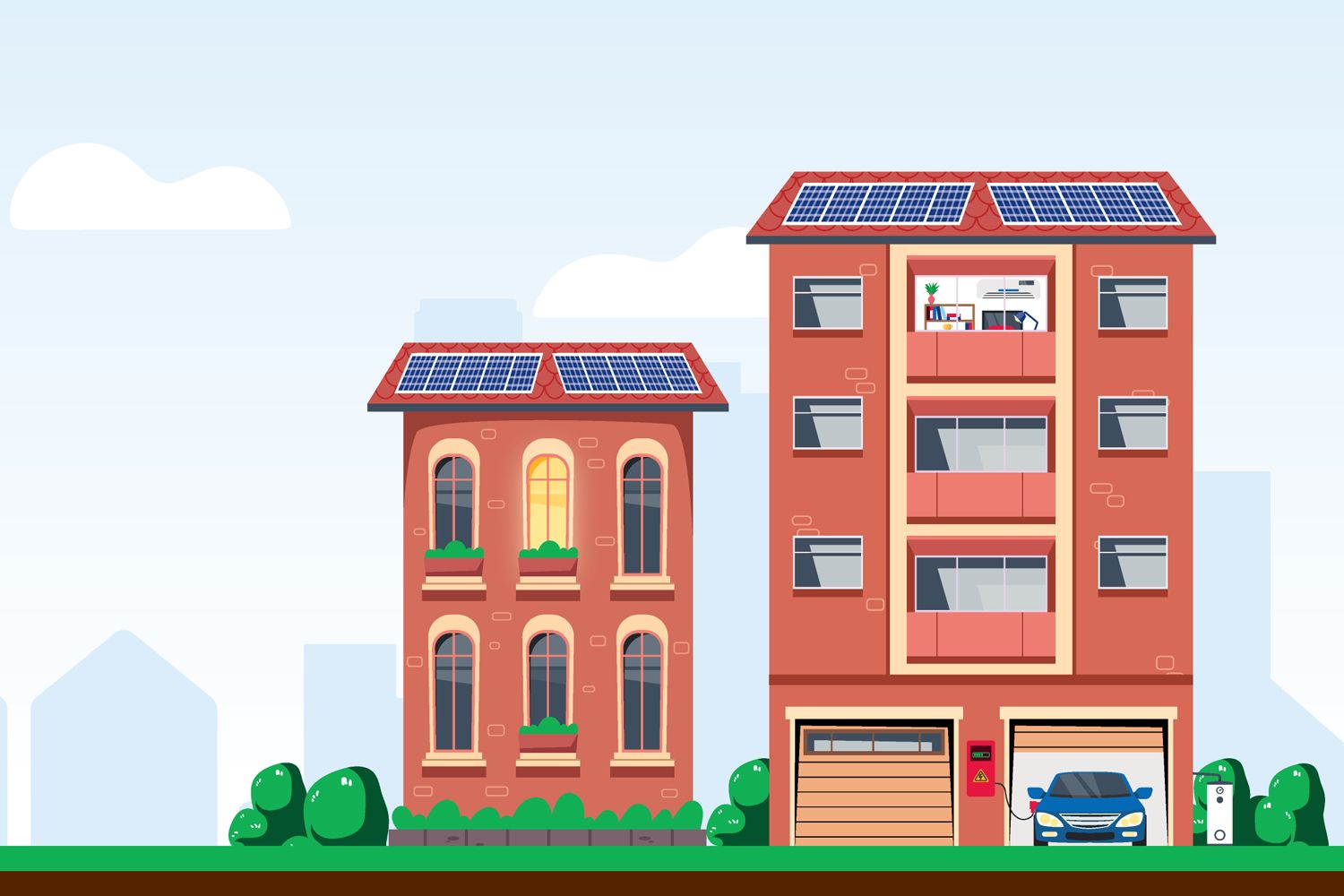
The illustration from the NSW Government's Solar for Apartment Residents page. Follow the source link for current program information. Illustrative image: NSW Government, Solar for apartment residents. Credit: © NSW Department of Climate Change, Energy, the Environment and Water. CC BY 4.0. Resized and cropped for display.
If you live in an apartment, a solar decision usually starts with the building rather than your individual electricity bill. Someone has to assess the shared roof, obtain comparable quotes, agree who pays and explain how residents will receive the electricity.
NSW currently has two Solar for Apartment Residents grant streams to help eligible buildings make that investment. The published application deadline is 5 pm AEDT on 4 December 2026, with earlier closure possible if funding is allocated. This is a guide to an existing program, checked on 17 October, not an announcement of a new rebate. Current program FAQs.
The distinction between the two streams matters. A headline saying that a grant pays 80% is not an offer available to every NSW apartment building.
Choose the correct grant stream first
The standard SoAR program offers up to 50% of eligible costs, capped at $150,000 per project. The Boost stream offers up to 80%, capped at $200,000 excluding GST, for eligible buildings in selected suburbs. Both require an owners corporation contribution and a successful application.
| Grant stream | Maximum contribution towards eligible costs | Project cap | Location check |
|---|---|---|---|
| SoAR | Up to 50% | $150,000 excluding GST | Eligible NSW properties |
| SoAR Boost | Up to 80% | $200,000 excluding GST | Selected eligible suburbs |
Sources: standard SoAR listing, Boost listing, and standard grant guidelines, revised September 2026.
Check the building's actual address against the government's eligible-suburb information before budgeting on Boost. A nearby qualifying suburb or a salesperson's broad description of your area is not enough.
The percentage is also limited by the project cap. A large project can leave the owners corporation paying more than the simple 50% or 20% balance, even before ineligible costs are considered.
An individual resident cannot simply claim the grant
Applications are made by the owners corporation or an authorised representative. A nominated resident can help, but needs the relevant authority. The Boost process includes an expression of interest followed by a full application, with comparable quotes and a sustainability infrastructure resolution required before the second stage. NSW Government's Boost application process.
For an owner, the practical first step is to ask the strata manager whether the committee has assessed shared solar and who would coordinate an application. For a renter, start with the property manager or landlord and ask whether the building has considered the program.
The Australian Government's guide for rented and multi-occupancy properties explains why both property ownership and shared-roof permissions matter. A landlord's interest in solar does not by itself authorise work on common property.
A useful initial request is specific: ask for an eligibility check and an outline of the next decision, rather than ask everyone to agree immediately to an installation.
Check the building before comparing panel brands
The standard guidelines target completed residential strata developments with 3 to 55 residential lots, appropriate building classifications and a common-property roof. Buildings with more than 55 but fewer than 100 lots are directed to seek advice if they otherwise meet the criteria. Existing solar, insurance and the proposed system also affect eligibility. Standard guidelines, section 2.
These are screening points, not a full eligibility decision. The committee should identify the relevant roof and electrical infrastructure before treating the building as suitable.
Put outstanding questions in one document: available roof area, any planned roof works, the position of meters, the proposed route to residential lots and the evidence still needed. That prevents a persuasive panel price from getting ahead of the actual building design.
Ask each supplier to quote against the same brief. If one proposal includes electrical upgrades and another leaves them as a later variation, the headline prices are not yet comparable. Our solar quote comparison guide provides a starting structure.
Work out the cash contribution properly
The NSW FAQs say the grant calculation uses the system cost after the STC discount and excluding GST. Interest and financing costs are not grant-funded. Official calculation guidance.
For an illustration only, suppose the assessed eligible amount is $60,000 after STCs and excluding GST. At the maximum percentage, standard SoAR would contribute $30,000 and Boost would contribute $48,000, assuming the project qualifies for the relevant stream. That would leave $30,000 or $12,000 respectively before any other amounts the owners corporation must fund.
Those are calculations using the published percentages, not installation prices, approvals or estimates for your building.
Ask for separate lines for eligible costs, ineligible work, GST treatment, any finance costs and ongoing service charges. Then ask when the money is needed. A building can have an affordable eventual contribution and still need a plan for payments before grant instalments arrive.
Avoid presenting an expected grant as money already available in the capital works fund.
Residents need an allocation plan they can understand
The standard program excludes a solar system that serves only common areas. It is intended to deliver shared solar to residents, rather than simply reduce the bill for a lift or hallway lighting. Standard SoAR exclusions.
Ask the designer to explain how electricity reaches residential lots and how the allocation relates to each lot's contribution. A diagram and an example using one apartment's meter can be more useful at a meeting than a long list of equipment specifications.
The standard guidelines also require a simple payback of no more than 10 years, assessed at strata level using the total purchase and installation cost, including both the grant and owners corporation contribution. Using only the reduced out-of-pocket contribution would not follow that stated test. Standard guidelines, section 2.3.
Ask to see the assumptions behind that calculation. How much generation is expected to be used within the building? Which electricity rates were used? What happens if actual usage differs?
For renters, there is another distinction: the FAQs say the grant does not regulate rental arrangements. Do not promise that a solar grant prevents a rent increase. Explain the proposed electricity benefit separately from tenancy matters. NSW FAQs.
Leave time for approval and delivery
The published completion and reporting deadline is 30 April 2027. The standard guidelines say installation must not begin until the funding deed has been signed by both parties. An expression of interest is not that signed funding deed. Standard guidelines, application timeline.
Work backwards from the deadlines with the strata manager and proposed supplier. Allow for the building's decision process, the application, any required information and delivery. Ask the program administrator about timing uncertainties before relying on an assumed extension.
The most useful outcome from the next committee discussion is a named coordinator, a clear eligibility question and a common brief for quotes. Residents can then assess an actual proposal: what it costs, who receives the benefit and who maintains it.
SolarAnswers' NSW rebate overview covers other forms of support. Treat each program separately when checking whether a proposed combination is permitted.
Sources and dates
All sources were accessed on 17 October 2026.
- NSW Government, standard SoAR grant listing: listed open when checked; application deadline 4 December 2026.
- NSW Government, SoAR Boost listing: listed open when checked; selected-suburb and contribution requirements.
- NSW DCCEEW, SoAR grant guidelines: cover states September 2026 revised, despite the older month in the filename.
- NSW DCCEEW, SoAR Boost guidelines: linked from the current program FAQ; read alongside the current Boost listing.
- NSW DCCEEW, program FAQs: updated 15 September 2026.
- Australian Government, Solar for rentals and multi-occupancy properties: no publication date displayed.
Written by the SolarAnswers editors
We link the reporting, government, industry or manufacturer sources behind each story below, and distinguish reported claims from our own analysis. We do not sell equipment, and no installer or brand pays to be written about. How we are paid
Sources
- NSW Government, standard SoAR grant listing
Checked 17 October 2026
- NSW Government, SoAR Boost listing
Checked 17 October 2026
- NSW DCCEEW, SoAR grant guidelines
Checked 17 October 2026
- NSW DCCEEW, SoAR Boost guidelines
Checked 17 October 2026
- NSW DCCEEW, program FAQs
Checked 17 October 2026
- Australian Government, Solar for rentals and multi-occupancy properties
Checked 17 October 2026
Comments
If comments do not appear, reload this page or browse the community.